
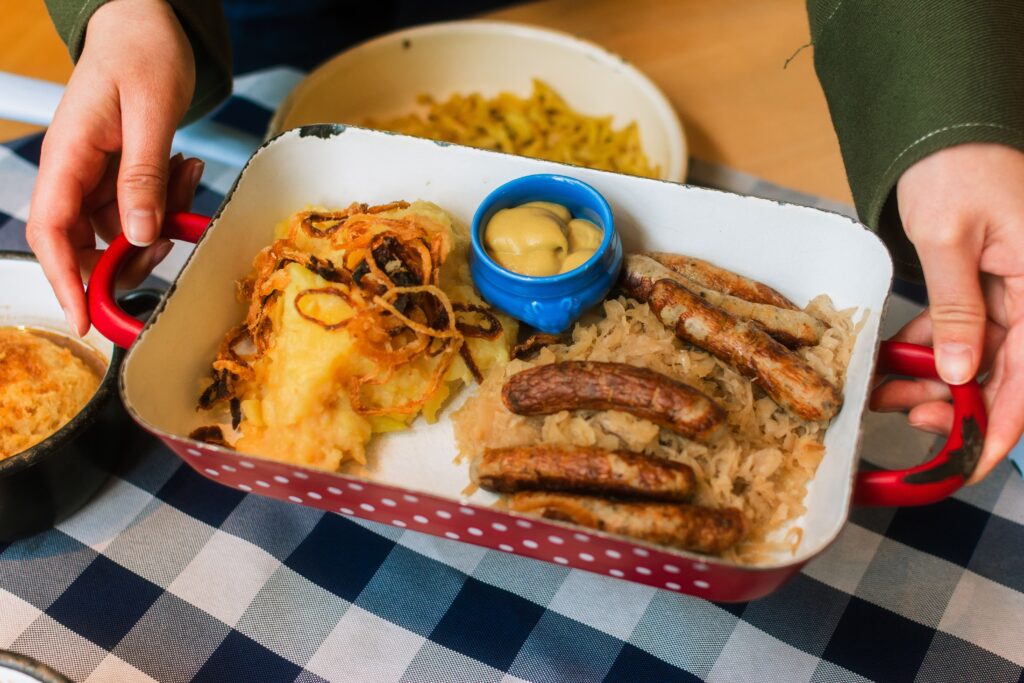
Bavarian food has a reputation that precedes it. Hearty, generous, built around meat, bread, and dairy, it is the kind of cooking that made sense for people working long hours in cold weather and needed something substantial to get through the day. What surprises most people when they actually cook these dishes at home is how straightforward many of them are. The techniques are not complicated, the ingredients are accessible, and the results are satisfying in a way that feels genuinely earned.
Whether you have just returned from a trip to Munich or you are planning one and want to understand the food better before you go, this guide walks you through the classic Bavarian dishes worth recreating at home and what makes each one work.
Schweinshaxe — Crispy Roasted Pork Knuckle
Schweinshaxe is probably the most recognisable Bavarian dish outside Germany. A whole pork knuckle, slow-roasted until the meat falls apart and the skin crackles, it is the kind of thing that looks impressive on the table but is mostly about patience rather than skill.
The key is scoring the skin deeply before roasting, which allows fat to render properly and gives you that distinctive crackling. A long roast at moderate heat, followed by a blast of high heat at the end, does most of the work. Dark beer, caraway seeds, and garlic in the roasting pan add the flavour base that makes the Bavarian version distinct from other pork roast traditions. If you want to taste the dish in its natural setting first, browsing Munich restaurants is a good way to find places that do a traditional version before you attempt your own at home.
Weisswurst — White Veal Sausage with Sweet Mustard
Weisswurst is a dish with rules. Traditionally eaten before noon, always with sweet mustard, always with a pretzel, and always removed from its casing before eating rather than sliced. The sausage itself is made from minced veal and pork back bacon, flavoured with parsley, lemon zest, and mace, then gently poached rather than fried or grilled.
Making Weisswurst at home requires sausage casings and a mincer, which is more equipment than most recipes demand, but the process is not technically difficult once you have the setup. The flavour payoff is significant. A freshly made Weisswurst is considerably more delicate than anything you will find vacuum-packed at a supermarket, and the texture is quite different from standard pork sausage.
Traditional Bavarian Dishes: Obatzda Cheese Spread
Obatzda is one of those dishes that looks like a minor side item but ends up being the thing everyone keeps eating. A soft cheese spread made from ripe Camembert, butter, cream cheese, and paprika, it is mixed together by hand until just combined rather than smooth, so it keeps some texture.
Caraway seeds, a splash of dark beer, and finely chopped onion go into the mix, and the result is something between a dip and a spread that works well with pretzels or rye bread. The flavour is strong, slightly funky from the ripe cheese, and deeply savoury. It comes together in about ten minutes and keeps well in the fridge for several days, which mak111es it a good choice when you are cooking Bavarian food over a weekend rather than a single sitting. For more ideas on incorporating bold global flavours into your home cooking, the Global Flavors and Fusions section on Renkooki covers a wide range of regional cuisines worth exploring alongside Bavarian food.
Käsespätzle — Bavarian Cheese Noodles
Käsespätzle is the Bavarian answer to macaroni cheese, and it is considerably better than most versions of that dish. Spätzle are small, soft egg noodles made by pushing a thick batter through a colander or spätzle press into boiling water. They cook in minutes and have a texture that holds up well against the sauce.
The cheese used is typically Emmental or a strong Alpine variety, grated generously over the hot noodles and then finished with crispy fried onions on top. The combination of soft noodles, melted cheese, and the crunch of the onion is straightforward but very effective. This is a dish that rewards good ingredients, particularly the cheese, which should be properly flavourful rather than mild.
Cooking Tips for Getting Bavarian Food Right at Home
A few principles apply across most of these recipes. Bavarian cooking does not rely on elaborate sauces or complex layering of flavours. What it relies on is good quality raw ingredients, proper seasoning at every stage, and not rushing the cooking process.
For pork dishes particularly, giving the meat enough time in the oven matters more than almost anything else. For the sausage and cheese dishes, using the best dairy and meat you can find makes a noticeable difference because there is not much else in the recipe to compensate. The Cooking Tips and Advice section on Renkooki has practical guidance on technique and ingredient selection that applies directly to this kind of traditional European cooking, where simplicity and quality are the whole point.
Conclusion
Traditional Bavarian dishes reward home cooks who are willing to slow down and let the ingredients do the work. Schweinshaxe, Weisswurst, Obatzda, and Käsespätzle each have a straightforward logic to them once you understand what makes each one distinct. The flavours are confident, the portions are generous, and the cooking is honest. Whether you are preparing a full Bavarian spread for a group or working through these dishes one at a time, the experience of making them at home is genuinely worth the effort.
 Brian Pinkertoniolusto writes the kind of cooking tips and advice content that people actually send to each other. Not because it's flashy or controversial, but because it's the sort of thing where you read it and immediately think of three people who need to see it. Brian has a talent for identifying the questions that a lot of people have but haven't quite figured out how to articulate yet — and then answering them properly.
They covers a lot of ground: Cooking Tips and Advice, Culinary Buzz, Global Flavors and Fusions, and plenty of adjacent territory that doesn't always get treated with the same seriousness. The consistency across all of it is a certain kind of respect for the reader. Brian doesn't assume people are stupid, and they doesn't assume they know everything either. They writes for someone who is genuinely trying to figure something out — because that's usually who's actually reading. That assumption shapes everything from how they structures an explanation to how much background they includes before getting to the point.
Beyond the practical stuff, there's something in Brian's writing that reflects a real investment in the subject — not performed enthusiasm, but the kind of sustained interest that produces insight over time. They has been paying attention to cooking tips and advice long enough that they notices things a more casual observer would miss. That depth shows up in the work in ways that are hard to fake.
Brian Pinkertoniolusto writes the kind of cooking tips and advice content that people actually send to each other. Not because it's flashy or controversial, but because it's the sort of thing where you read it and immediately think of three people who need to see it. Brian has a talent for identifying the questions that a lot of people have but haven't quite figured out how to articulate yet — and then answering them properly.
They covers a lot of ground: Cooking Tips and Advice, Culinary Buzz, Global Flavors and Fusions, and plenty of adjacent territory that doesn't always get treated with the same seriousness. The consistency across all of it is a certain kind of respect for the reader. Brian doesn't assume people are stupid, and they doesn't assume they know everything either. They writes for someone who is genuinely trying to figure something out — because that's usually who's actually reading. That assumption shapes everything from how they structures an explanation to how much background they includes before getting to the point.
Beyond the practical stuff, there's something in Brian's writing that reflects a real investment in the subject — not performed enthusiasm, but the kind of sustained interest that produces insight over time. They has been paying attention to cooking tips and advice long enough that they notices things a more casual observer would miss. That depth shows up in the work in ways that are hard to fake.