
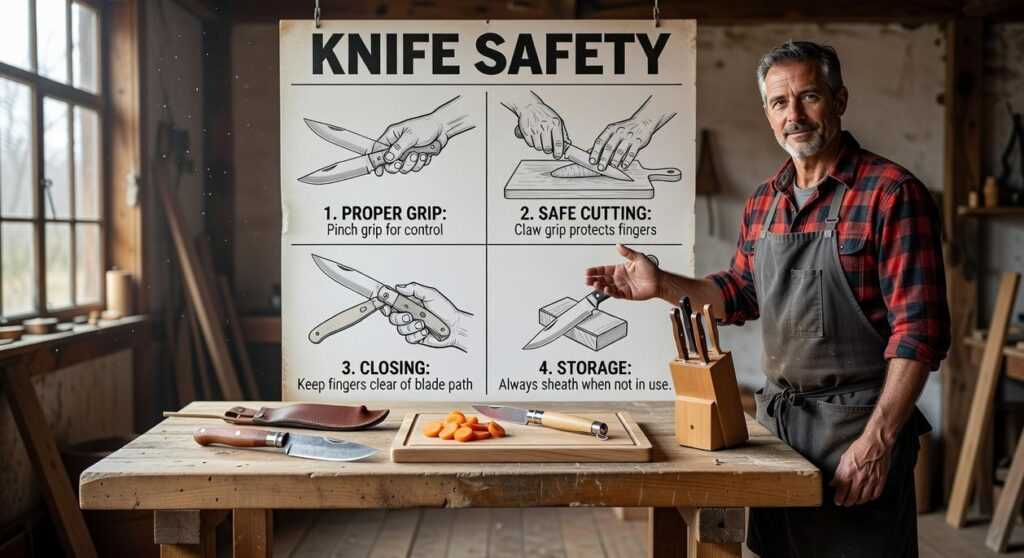
If you’ve ever searched for a clear, practical way to improve your knife confidence in the kitchen, this basic knife skills guide is designed for you. Whether you’re tired of uneven cuts, slow prep times, or feeling unsure with a chef’s knife in hand, mastering the fundamentals can completely transform how you cook.
This article focuses on what truly matters: proper grip, safe cutting techniques, consistent slicing, and smart prep habits that save time and reduce waste. By breaking down essential movements into simple, repeatable steps, you’ll gain the control and precision used in professional kitchens—without the overwhelm.
Our culinary insights are grounded in hands-on kitchen experience, global flavor exploration, and tested prep methods that prioritize both safety and efficiency. Every tip shared here is practical, field-tested, and designed to help you build real, lasting skills.
If your goal is faster prep, cleaner cuts, and more confidence at the cutting board, you’re in the right place.
Unlock Your Culinary Potential: A Foundation in Knife Skills
Mastering the art of chopping not only enhances your culinary precision but also prepares you to skillfully combine vibrant flavors when you dive into blending Mediterranean and Middle Eastern ingredients at home – for more details, check out our How to Blend Mediterranean and Middle Eastern Ingredients at Home.
You want to move from clumsy chopping to confident, efficient prep. The problem? Inconsistent cuts mean uneven cooking, while poor technique slows you down and raises the risk of injury (yes, that dull knife is more dangerous than you think). Some argue fancy knife work is only for chefs or that gadgets do the job faster. Fair—but tools can’t replace fundamentals. Mastering a basic knife skills guide builds control, speed, and safety. By the end, you’ll understand the core theory and practical steps that transform everyday slicing into smooth, professional-level prep at home.
Your Essential Kitchen Arsenal: The Only Three Knives You Need
Forget the 15-piece knife block (half of which you’ll never touch). Over 90% of kitchen tasks rely on three essentials.
The Chef’s Knife
The 8-inch chef’s knife is the workhorse. Its broad blade and curved edge allow a smooth rocking motion for chopping herbs, slicing proteins, and dicing onions with precision. High-carbon stainless steel models hold a sharper edge longer, meaning cleaner cuts and less food bruising. In practical terms: faster prep, better texture, happier dinners.
The Paring Knife
Small but mighty, the 3–4 inch paring knife excels at peeling apples, trimming fat, and executing intricate cuts. Its compact blade gives fingertip control—ideal when detail matters.
The Serrated Knife
With a saw-like edge, the serrated knife grips crusty bread and delicate tomatoes without crushing them. It’s the specialist you’ll reach for more than you expect.
Bonus Tip: Use a stable wood or plastic cutting board to protect blade sharpness and prevent slipping. For fundamentals, follow a basic knife skills guide.
Mastering Control: How to Hold Your Knife and Food Safely
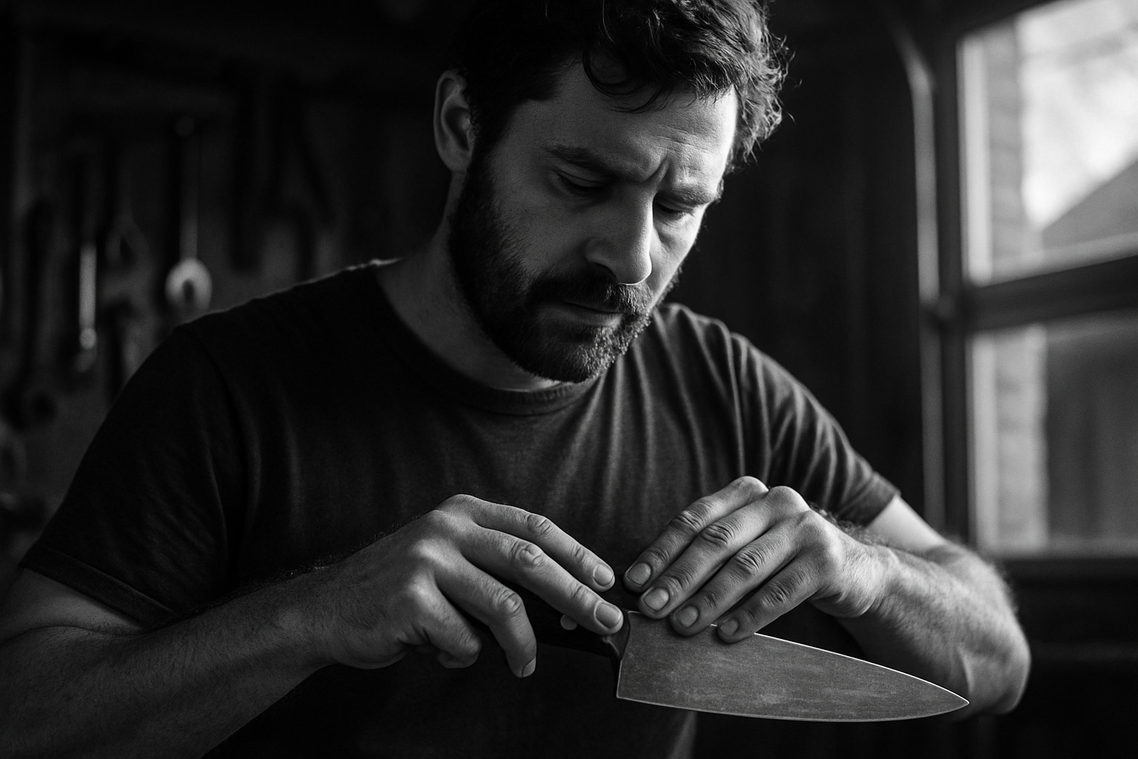
The most important lesson I ever learned in the kitchen came with a Band-Aid.
Years ago, I was rushing through onions, gripping the handle like I was holding a hammer (spoiler: that’s not how you do it). One slip reminded me that control isn’t optional—it’s foundational.
The Non-Negotiable Foundation
The Knife Hand: The Pinch Grip
Place your thumb and index finger directly on the blade, just in front of the handle. This is called the pinch grip—a technique where you “pinch” the blade itself for maximum stability. Wrap your remaining three fingers around the handle. The result? Better balance, cleaner cuts, and far less wobble. Think of it as power steering for your knife.
The Guide Hand: The Claw Grip
Curl your fingertips under so your knuckles face the blade. This claw grip lets the flat side of the knife glide against your knuckles while keeping fingertips safely tucked away. This is the ultimate safety technique. Professional kitchens rely on it for speed and precision (and intact fingers).
Body Mechanics Matter
Stand straight, feet shoulder-width apart, and cut away from your body. A stable stance creates a safe cutting station.
Master these basics once, and every basic knife skills guide will finally click.
From Rough Chop to Fine Dice: Your First Four Essential Cuts
Mastering four foundational cuts transforms chaotic prep into controlled cooking. In fact, professional kitchens emphasize uniform knife work because evenly cut food cooks evenly—a principle backed by culinary science and reinforced in training programs worldwide (CIA, 2011). So let’s break it down step by step.
1. The Slice
The slice is your starting point. First, create a stable base—a flat surface made by trimming one side of a round vegetable like an onion or potato. This prevents rolling (and saves your fingertips). Then, with your knife perpendicular to the board, cut uniform planks.
Uniformity matters: when potato slices vary in thickness, thinner pieces overcook while thicker ones remain underdone. Consistency equals control.
2. The Julienne (Matchstick)
Next, stack your planks neatly. Cut them lengthwise into thin strips about 1/8 inch thick. This is the julienne—think crisp carrots in a stir-fry or daikon in a salad.
Because the strips are similar in size, they cook at the same rate. Research in heat transfer shows smaller, consistent pieces promote even thermal penetration (McGee, On Food and Cooking). In other words, no random crunchy surprises.
3. The Dice (Brunoise, Small, Medium)
Now gather your julienned strips and rotate them 90 degrees. Slice crosswise to create cubes.
- Brunoise: 1/8 inch cubes (fine garnish)
- Small dice: 1/4 inch cubes (salsas, sauces)
- Medium dice: 1/2 inch cubes (soups, stews)
Precise dice ensure balanced flavor distribution in every bite (yes, that’s why restaurant salsa tastes “better”). If you need a refresher, consult a reliable basic knife skills guide before practicing.
4. The Mince
Finally, for garlic or herbs, gather pieces into a pile. Rock the chef’s knife back and forth, keeping the tip anchored. Continue until almost paste-like.
Because smaller particles release more surface oils, minced garlic delivers stronger aroma—confirmed by flavor compound studies in food chemistry.
And once you’ve prepped everything, don’t forget smart storage solutions to keep ingredients fresh longer: https://renkooki.com/smart-storage-solutions-to-keep-ingredients-fresh-longer/.
Practice these cuts consistently. Precision isn’t just aesthetic—it’s science-backed efficiency.
Maintaining Your Edge: Simple Rules for Knife Care
A sharp knife is a safe knife. That sounds backward—shouldn’t dull be safer? Actually, a dull blade is like worn-out tires on a car: it slips when you need control most. Because it can’t bite into food cleanly, you push harder, and that extra force makes it more likely to skid off an onion and onto your finger (not the kind of slice you’re aiming for).
Understanding care starts with knowing the difference between honing and sharpening:
- Honing realigns the edge. Think of it as combing tangled hair straight again. Do this frequently.
- Sharpening removes metal to form a brand-new edge. It’s a reset button—use it sparingly.
Cleaning and storage are the cardinal rules. Hand-wash and dry immediately. Never put a good knife in the dishwasher. Store it in a block, on a magnetic strip, or with a blade guard. Treat it like a lightsaber—respect the edge. For more fundamentals, see our basic knife skills guide.
By now, your intent to learn the basics is met: you understand essential tools, proper grips, core cuts, and smart knife care. The original frustration—slow, uneven prep work that turns dinner into a chore—doesn’t have to define your cooking anymore. These fundamentals work because they create a foundation of safety and efficiency; once movements are consistent, creativity follows (yes, even weeknight stir‑fries feel gourmet). If you need a refresher, revisit the basic knife skills guide. Practice is the final ingredient. Start with an onion or potato and drill the slice, julienne, and dice until they feel natural and confidently cook.
Master Your Kitchen with Confidence
You came here to sharpen your technique and feel more confident handling a knife in your kitchen. Now you understand how proper grip, controlled cuts, and steady practice can completely transform your cooking experience.
Struggling with uneven slices, slow prep time, or worrying about safety can take the joy out of cooking. The truth is, without strong fundamentals, even the best ingredients won’t shine. That’s why mastering the basics isn’t optional—it’s essential.
Here’s your next move: revisit this basic knife skills guide, practice one technique at a time, and commit to improving your precision every time you cook. Small, consistent improvements lead to faster prep, better presentation, and more confidence at the cutting board.
Thousands of home cooks elevate their skills by focusing on technique first. If you’re ready to stop second-guessing your cuts and start cooking with ease, put these skills into action today and make every slice count.
 Regina Hoodecons has opinions about global flavors and fusions. Informed ones, backed by real experience — but opinions nonetheless, and they doesn't try to disguise them as neutral observation. They thinks a lot of what gets written about Global Flavors and Fusions, Culinary Buzz, Renkooki Culinary Experimentation is either too cautious to be useful or too confident to be credible, and they's work tends to sit deliberately in the space between those two failure modes.
Reading Regina's pieces, you get the sense of someone who has thought about this stuff seriously and arrived at actual conclusions — not just collected a range of perspectives and declined to pick one. That can be uncomfortable when they lands on something you disagree with. It's also why the writing is worth engaging with. Regina isn't interested in telling people what they want to hear. They is interested in telling them what they actually thinks, with enough reasoning behind it that you can push back if you want to. That kind of intellectual honesty is rarer than it should be.
What Regina is best at is the moment when a familiar topic reveals something unexpected — when the conventional wisdom turns out to be slightly off, or when a small shift in framing changes everything. They finds those moments consistently, which is why they's work tends to generate real discussion rather than just passive agreement.
Regina Hoodecons has opinions about global flavors and fusions. Informed ones, backed by real experience — but opinions nonetheless, and they doesn't try to disguise them as neutral observation. They thinks a lot of what gets written about Global Flavors and Fusions, Culinary Buzz, Renkooki Culinary Experimentation is either too cautious to be useful or too confident to be credible, and they's work tends to sit deliberately in the space between those two failure modes.
Reading Regina's pieces, you get the sense of someone who has thought about this stuff seriously and arrived at actual conclusions — not just collected a range of perspectives and declined to pick one. That can be uncomfortable when they lands on something you disagree with. It's also why the writing is worth engaging with. Regina isn't interested in telling people what they want to hear. They is interested in telling them what they actually thinks, with enough reasoning behind it that you can push back if you want to. That kind of intellectual honesty is rarer than it should be.
What Regina is best at is the moment when a familiar topic reveals something unexpected — when the conventional wisdom turns out to be slightly off, or when a small shift in framing changes everything. They finds those moments consistently, which is why they's work tends to generate real discussion rather than just passive agreement.